
2055 Socioeconomic and Demographic Forecasts
Thank You for Joining Us at the Metro Growth Summit
Thank you to everyone who joined us for the Metro Growth Summit on September 22. We appreciate the time, perspectives, and thoughtful discussion from community leaders and stakeholders about the opportunities and challenges that could shape future growth in the Fargo-Moorhead region.
Input from the Summit will help inform Metro COG’s 2055 socioeconomic and demographic forecasts, including future population, household, and employment growth.
Share Your Perspective
Whether or not you were able to attend the Summit, we welcome your input through our short Employment Growth Factors Survey. The survey asks about factors that could influence future employment growth across the Fargo-Moorhead region.
Please complete the survey by Friday, October 2.
Take the Employment Growth Factors Survey
Thank you again to everyone who participated in the Metro Growth Summit and contributed to the conversation about the region’s future.
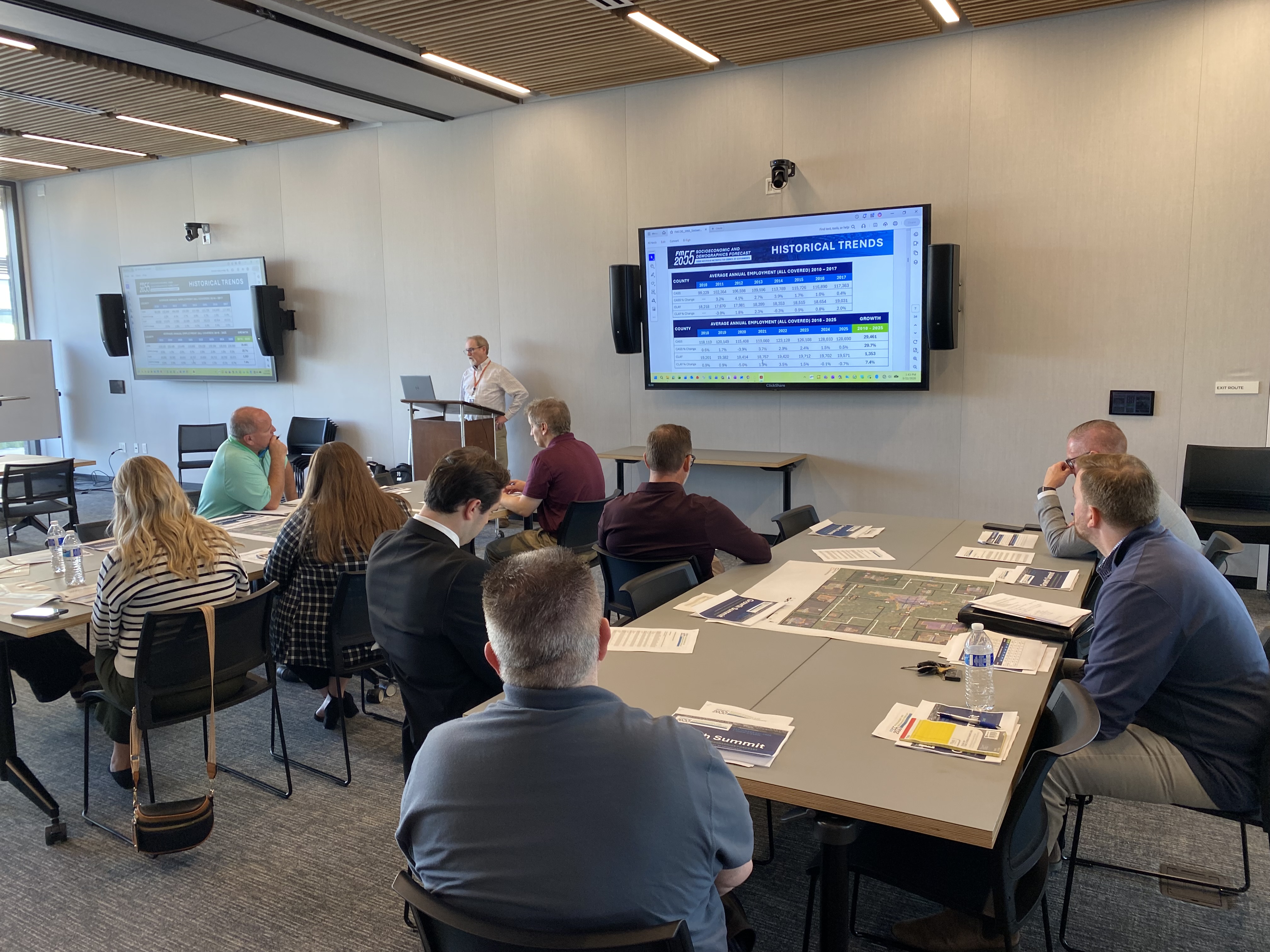
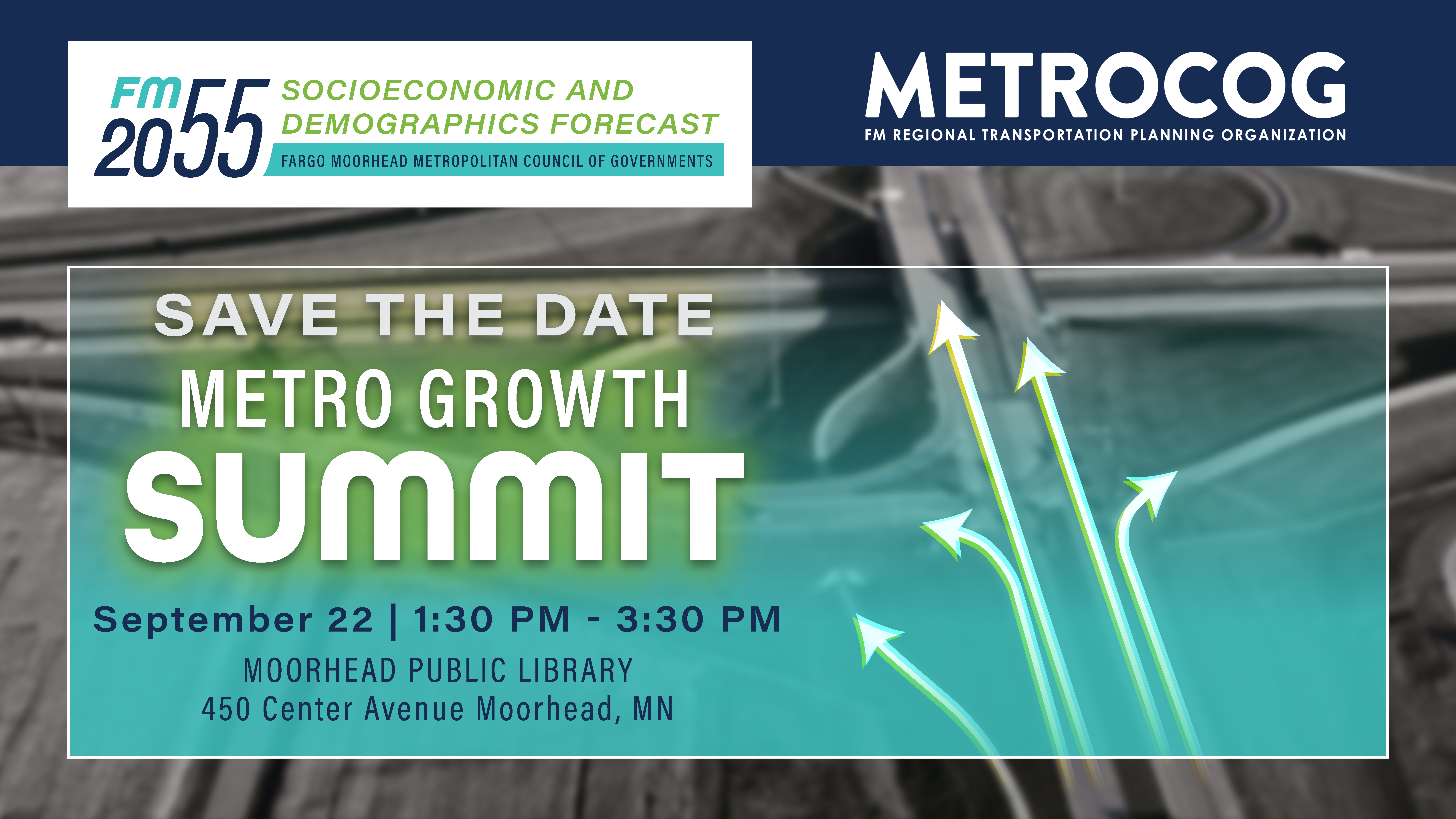
Metro Growth Summit - September 22, 2026
The Fargo-Moorhead metropolitan area continues to grow and evolve, influenced by changes in population, housing, employment, education, development, and regional investment. Understanding how these factors may shape the region over the next 30 years is critical to planning for future transportation, infrastructure, housing, and community needs.
Metro COG invites community leaders and regional stakeholders to participate in the Metro Growth Summit supporting the development of the region’s 2055 Socioeconomic and Demographic Forecasts.
The Growth Summit will bring together local governments, economic development organizations, educational institutions, major employers, developers, and other community partners for a focused discussion about the forces shaping the region’s future. Participants will be asked to share their perspectives on emerging trends, opportunities, constraints, and other factors that may influence future population, household, and employment growth.
Your perspective is important. The knowledge and experience of regional leaders will help Metro COG and its project team evaluate forecast assumptions and better understand how current and emerging conditions may affect the pace and location of growth throughout the Fargo-Moorhead region.
Project Background Information
Demographic forecast data is a critical component of Metro COG’s metropolitan planning program. While these forecasts support a variety of regional and local planning activities, a primary purpose is to maintain and update Metro COG’s regional travel demand model (TDM).
Planning for future transportation and infrastructure needs requires a realistic understanding of the region’s future population, households, and employment. Because these forecasts will serve as an important planning resource for communities throughout the metropolitan area, the methodology used to develop them must be transparent, understandable, and supported by reliable data.
The study will update regional forecasts for population, households, and employment through 2055. Forecasts will be developed at multiple geographic levels, including the Metropolitan Statistical Area (MSA), counties, cities, townships, and transportation analysis zones (TAZs), as appropriate. The study will also examine characteristics such as age, household size, and income.
Historically, the Fargo-Moorhead metropolitan area has experienced sustained growth supported by a diverse regional economy and major economic sectors including higher education, healthcare, agriculture, and manufacturing. The updated forecasts will evaluate recent demographic and economic trends and their implications for the region’s long-term growth.
Project Objective
The objective of this study is to develop updated socioeconomic and demographic forecasts for the Fargo-Moorhead metropolitan area through 2055.
Metro COG’s most recent demographic study was completed in 2022 and developed projections through 2050 for the Fargo-Moorhead MSA, consisting of Cass County, North Dakota, and Clay County, Minnesota. Metro COG’s metropolitan planning area encompasses portions of both counties, including approximately 30 townships, and generally corresponds with the geographic extent of Metro COG’s regional travel demand model. The region’s principal urban communities include Fargo, West Fargo, and Horace in North Dakota and Moorhead and Dilworth in Minnesota.
The 2055 socioeconomic and demographic forecasts are intended to:
- Evaluate previous forecasts and travel demand model assumptions to assess their accuracy and continued validity;
- Develop updated population, household, and employment forecasts at multiple geographic scales, including TDM forecast-year datasets for 2035 and 2055; and
- Support long-range planning, including the next update of the Fargo-Moorhead Metropolitan Transportation Plan (MTP), anticipated to begin in 2028, while providing local jurisdictions and regional partners with consistent demographic information for their own planning activities.
Project Resources
Project Contact Information
Adam Altenburg
altenburg@fmmetrocog.org
(701) 532-5105
Fargo-Moorhead Metropolitan Council of Governments
One 2nd Street N, Suite 232
Fargo, ND 58102